Wire drawing is a metalworking process used to reduce the cross-section of a wire by pulling the wire through a single, or series of, drawing die(s). Wire drawing is a deformation process in which the cylindrical bar or rod workpiece is pulled through a converging die. However, the material is subjected to compressive stress within the die thereby deforming plastically. A rod is drawn down in order to reduce its diameter. In general, drawing results in a reduction in the area of the cross-section. Drawn rods are used as raw materials for making bolts etc. Wire drawing is usually done in multiple steps, using 4 to 12 dies, because the length of the wire drawn is very large-several meters.
Cold working by wire drawing gives advantages in size accuracy, straightness, and increased mechanical properties when compared to its hot drawing counterpart. Cold Drawn wire exhibits a bright and almost polished finish and will have improved machining characteristics making it ideal for production.
In this process, pearlite, the raw material (wire rod) structure, is converted into a stable spherical carbide to lower its strengths and expand its ductility, thus improving transmutability during cold forging.
In this process, the pickled and coated material is passed through dies to draw wire with the required wire diameters. In this process, the pearlite structure is segmented through cold processing to facilitate spheroidizing during annealing and to adjust wire drawing reduction ratios to meet the required machine properties after wire drawing.
Pelican Engitech utilizes cutting-edge technology. Throughout the operation, advanced computerization programming is used (including CAD and Statistical Process Control). Simulation software is used by engineering to improve tooling life and run-time efficiency for each part.
Cold forging is often used in the production of high-strength, complex-shaped metal parts for a variety of applications such as automotive, aerospace, and medical industries. Compared to other manufacturing processes like casting, machining or heat treatment, cold forging can provide several benefits, including higher productivity, better material utilization, improved mechanical properties of the finished part, and reduced energy consumption.
Some other key advantages of the cold forming process can include a higher dimensional accuracy than with forged parts, excellent surface quality, and no need to apply additional energy into the process such as extreme temperatures.
EBRO supplies efficient turn-key products for our customers by handling all the secondary operations. We recognized the need to customize parts or modify standards to meet our customer’s needs. We can take your secondary headaches away due to our in-house operations. Secondary Operations such as Grinding, Polishing, Tapping, Counter boring, Cutoffs, Drilling / Milling / Slotting / Thread Rolling / Cutting, Thread Locking / Chasing and Others (As per Customer Drawing) can be carried out.
The six-station cold heading machine for nut production. These machines can produce nuts with improved mechanical properties, high quality and at a relatively low production cost. The increased positioning capabilities of the machine allow for the production of both low and high nuts, as well as nuts with reduced turnkey size. Additionally, the machine provides the ability to produce special products, which can help us to expand our product range.
Hexagon Nuts are mass manufactured using a similar multi-station cold former that twists the fastener over between forging stations to allow forging of both faces of the nut. Nut formers or nut formers are the names given to these machines. The last blow on a nut former is to puncture a hole in preparation for the nut to be tapped with an internal thread later.
Roll threading is a cold-forming process that is commonly used to produce threads on bolts. In this process, a set of hardened steel dies are used to form the threads onto the bolt by extending into the outer diameter of the blank bolt. It is important to note that threading is often performed before heat treatment while the steel is still soft, either by rolling or cutting. This is because the steel is easier to work with in its soft state, and it allows for more precise and accurate threading.
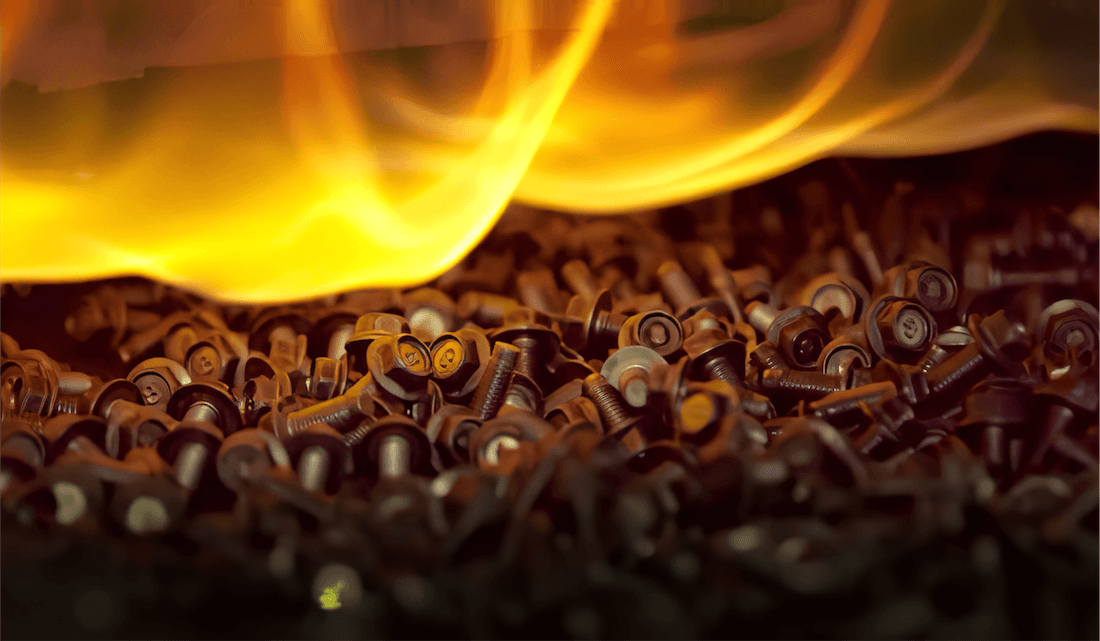
EBRO Fastener operates in Continuous Mesh Belt Furnaces with continuous load rate, atmosphere, hardening, tempering, and quench monitoring. Heat treatment of fasteners and fixings is a critical part of the manufacturing process. The control of temperature, time and atmosphere determines the quality, capability and reliability of the fastener. Fastener finished properties have complied with a targeted strength range.
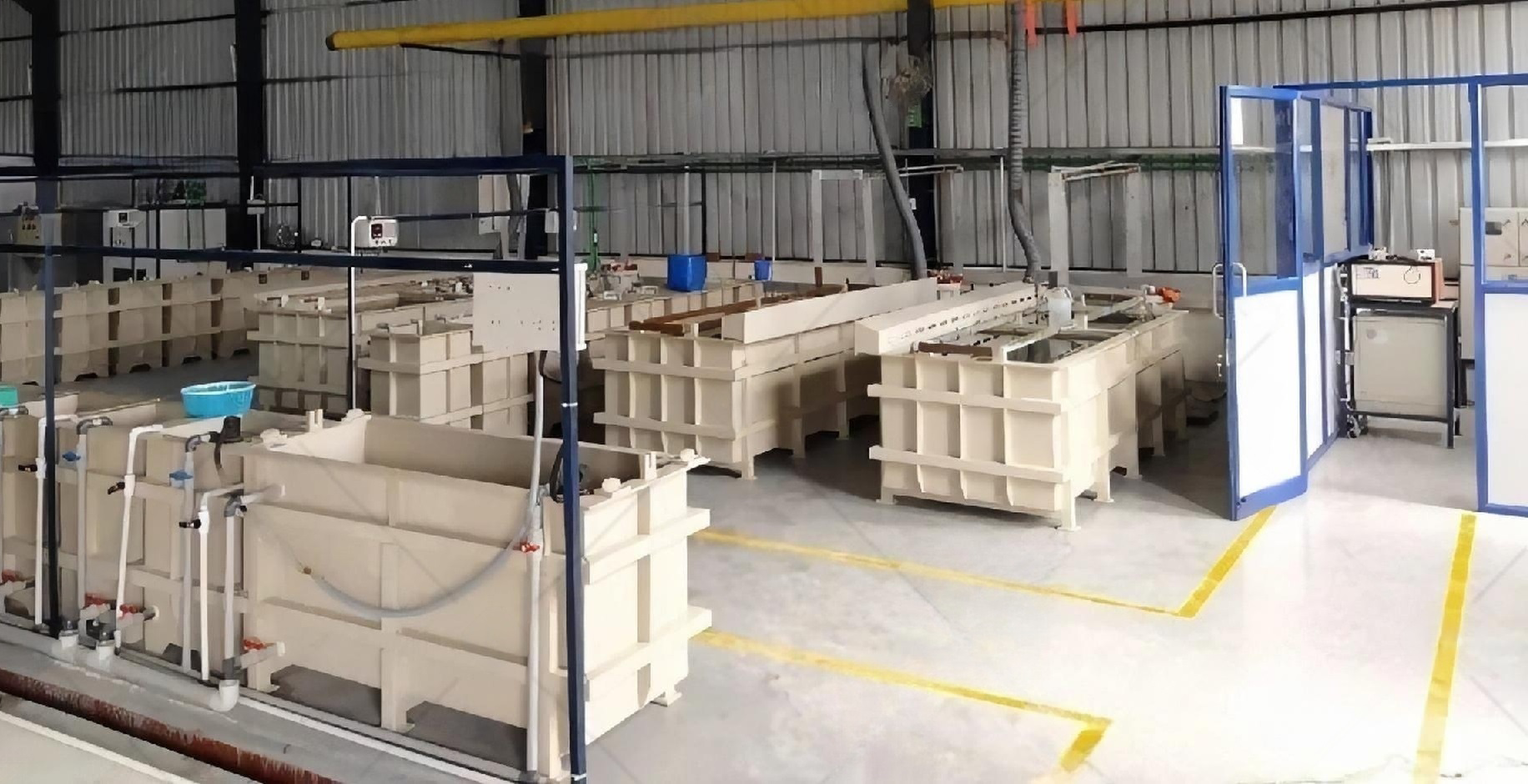
The electroplating process involves cleaning the fastener in an alkaline solution and removing rust with acid. Cleanliness is essential to ensure the adhesion of the coating. The fasteners are then dipped in a zinc-containing chemical bath for electro-deposition. DC current dissolves zinc at the anode, sending metal ions to the cathode to create a coating. Coating thickness varies with time, current, and bath chemistry.
We have a 100% fully functional ETP (Effluent Treatment Plant) is a process design for treating industrial wastewater for its reuse or safe disposal to the environment.
Effluent treatment plant cleans industrial effluents, contaminated water from outlet pipes, etc. and reclaim the water resource for using in different purposes. Whenever there is a chance of extreme water contamination. These treatments are applied depending on many aspects or characteristics of the waste water and available space or location of the plants.
Why is ETP Required?
Broadly, the industrial process is having a negative influence on the environment. Pollution from inappropriate industrial wastewater treatment is a major environmental concern in India, particularly in the country's burgeoning small-scale manufacturing sector. Adoption of cleaner manufacturing technologies and waste reduction techniques is gaining popularity as a means of reducing industrial pollution discharge. Effluent Treatment Plants (ETPs) are one of the wastewater treatment options available to small and medium-sized industries.